Asphalt Doctor delivers expert utility patching solutions throughout Bakersfield and Central Valley.
Our certified team specializes in permanent trench repairs, T-section bridge patches, and infrared patching using engineered materials and proven techniques.
With 25 years serving Kern County’s demanding conditions, we provide professional utility cut restoration that restores structural integrity, prevents water infiltration, and ensures seamless surface integration.
Our certified utility patching contractors specialize in restoring asphalt surfaces after utility cuts, trench work, and infrastructure repairs throughout Bakersfield. We use hot mix asphalt and proven compaction techniques to ensure seamless, durable patches that blend with existing pavement and resist settlement or cracking. Each patch is carefully prepped and finished to handle heavy traffic and Bakersfield’s extreme weather conditions. Asphalt Doctor delivers reliable utility patching solutions that restore pavement integrity, extend surface life, and maintain safety and function across roads, parking lots, and commercial properties in the Central Valley.
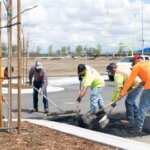
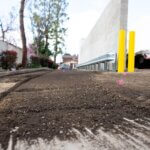
Professional full-depth utility patching for water line, sewer, and electrical utility cuts throughout Bakersfield commercial and municipal properties. Advanced excavation and backfill techniques ensure proper compaction and base stability. Hot mix asphalt installation provides permanent restoration that matches surrounding pavement performance and eliminates future settling issues.
Strategic T-section utility patching technique that offsets joint locations between pavement layers for enhanced structural integrity. Professional bridge patching extends beyond trench edges 6-12 inches to rest on undisturbed base materials. This advanced method prevents weak planes and provides superior long-term performance for utility cuts throughout Kern County.
Rapid emergency patching services for critical utility cuts requiring immediate restoration throughout the Bakersfield area. Professional cold mix applications provide temporary safety solutions while permanent hot mix repairs follow within 24-48 hours. Emergency protocols ensure traffic safety and prevent liability issues during utility emergencies.
Advanced infrared heating technology creates seamless utility patches by recycling existing asphalt materials. Professional infrared patching eliminates cold joints and provides permanent thermo-bonded repairs. Ideal for utility cuts requiring superior water resistance and structural continuity in high-traffic applications throughout Central Valley.
Local Expertise
As expert utility patching contractors in Bakersfield, CA, we understand local soil, streets, and utility demands.
Precision Repairs
We deliver accurate, long-lasting patching that restores surface strength and blends seamlessly with surroundings.
Fast Response
Our team is always ready to respond quickly, minimizing downtime and keeping your operations running smoothly.
Compliance Driven
We follow all municipal and utility regulations to ensure every patch is safe, legal, and long-lasting.
Advanced Equipment
Using modern tools and materials, we guarantee durable patches that hold up under heavy wear and pressure.
Trusted Professionals
We’re known for reliable service, honest pricing, and quality results you can count on for every utility repair.
Asphalt utility patching is the specialized repair of pavement sections that were excavated for underground utility work such as water, sewer, gas, or electrical line installation and maintenance. Unlike regular patching that addresses surface deterioration, utility patching involves restoring pavement structure after deliberate excavation that extends through multiple pavement layers. This creates unique challenges because the repair must rebuild the entire pavement structure from the subgrade up, requiring careful attention to layer bonding, compaction, and structural continuity.
The T-section or bridge patch technique involves cutting away an additional 6-12 inches of pavement surface on either side of the utility trench before filling it. This creates a T-shaped cross-section where the patch material bridges over the trench and rests on the original, undisturbed base material. This technique offsets the locations of patch joints in different pavement layers, preventing a continuous plane of weakness from running through multiple layers and allowing the patch to be partially supported by the existing compacted base.
Compaction in utility patching is challenging due to limited working space within the excavated trench and the difficulty of achieving proper density in confined areas. The backfill material used to fill the trench may be different from the existing base, requiring different compaction techniques. Standard compaction equipment may not fit within narrow trenches, and achieving uniform density throughout the depth of the repair is difficult. Poor compaction of either the backfill material or the patch surface significantly reduces the repair’s lifespan and can lead to settlement and surface failure.
Utility patches create joints where they meet the existing pavement, making the surface more permeable and vulnerable to moisture infiltration. These joints can allow water to penetrate directly into the pavement structure, particularly problematic when the joint runs directly over the trench walls. Water infiltration can weaken the bond between asphalt layers, cause stripping of the asphalt-aggregate bond, and lead to freeze-thaw damage in cold climates. Proper joint sealing and achieving desired compaction density at the joint interface are essential to prevent these issues.
Structural integrity depends on proper reconstruction of the pavement’s layered system, including adequate compaction of backfill material to match the surrounding base density, proper bonding between new and existing pavement layers, and maintaining continuity of the load-bearing structure. The patch must be able to distribute traffic loads effectively to prevent localized failure. Key factors include the quality of subgrade preparation, appropriate material selection for each layer, proper thickness of the patch material, and achieving specified compaction densities throughout the repair depth.
Seasonal conditions significantly impact utility patching success, particularly regarding material performance and application techniques. Cold weather below 50°F prevents proper bonding of hot mix asphalt and affects compaction effectiveness, while frozen ground complicates excavation and backfill operations. Hot mix asphalt is preferred for permanent repairs but requires suitable temperature conditions for placement and compaction. Cold mix asphalt can be used in adverse weather but provides only temporary repairs. Moisture from rain or snow interferes with bonding and can cause problems with joint sealing.
Long-term performance of utility patches is typically inferior to the surrounding pavement due to the inherent structural discontinuity created by the repair. Even properly constructed patches create weak points in the pavement structure that are more susceptible to traffic loading, moisture infiltration, and temperature cycling. The patch-to-pavement interface is particularly vulnerable to cracking and separation over time. Successful long-term performance depends on proper initial construction, regular maintenance including joint sealing, and monitoring for signs of distress that may require additional repair or reconstruction.